Hey you. If you are tired of staring down at your phone while walking into street poles, I completely get it. I spent years dealing with a stiff neck until I finally swapped my basic frames for wearable tech. Now, every single day, someone stops me to ask: How Do Smart Glasses Work? Cameras, AI, Bluetooth, Speakers & Displays Explained.
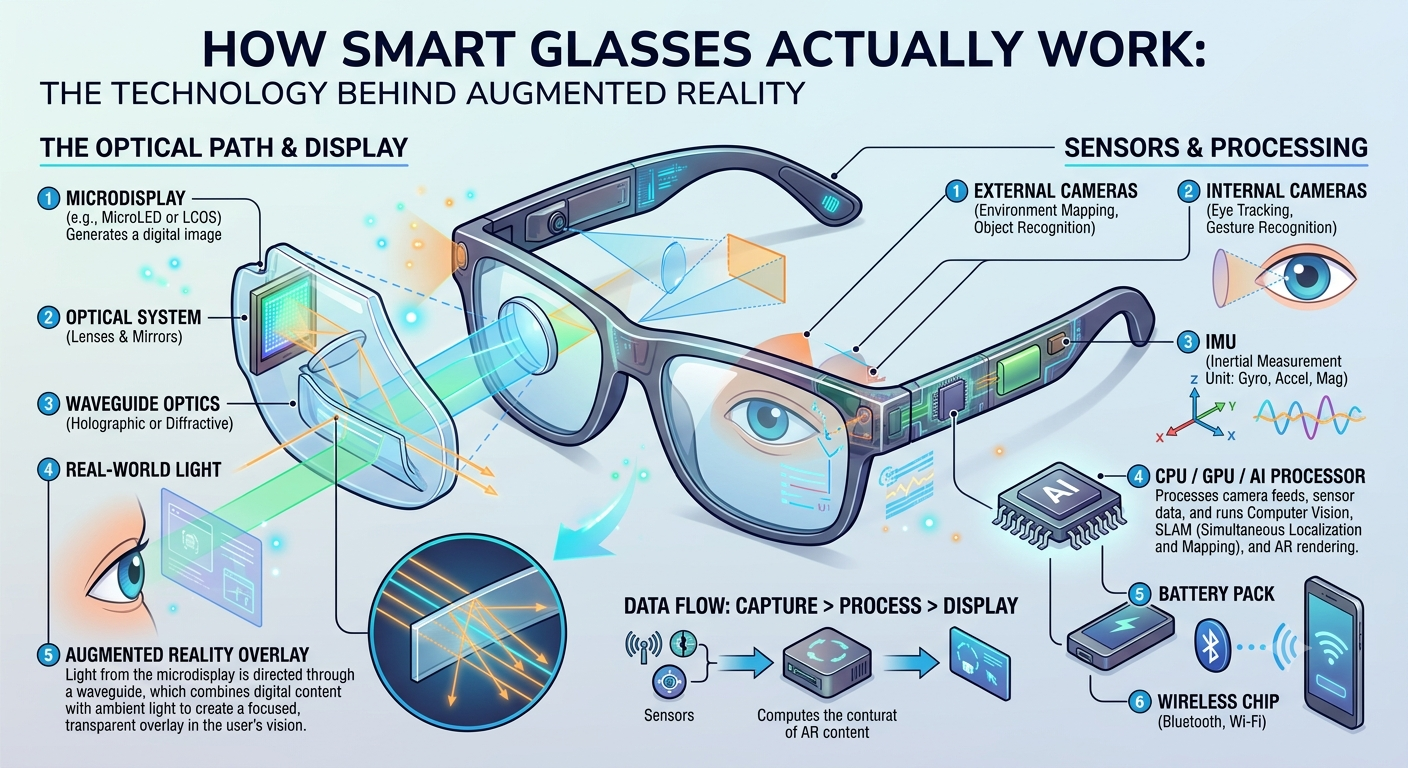
TBH if you know what smart glasses are then the technology sounds like magic, but it is actually just a clever packing job of tiny computer parts. You do not need a tech degree to understand what is sitting on your face. Let’s break down exactly how these sleek new frames replace your phone, earbuds, and camera all at once.
Why We Are Ditching Phone Screens
Newsflash! Pulling a heavy glass brick out of your pocket 150 times a day is officially outdated. I used to juggle my phone, a bulky pair of earbuds, and my regular everyday eye glasses just to go on a simple coffee run. It was a cluttered, annoying mess that left my hands constantly tied up.
Shifting to smart frames fixed all of that instantly. You get your daily prescription glasses, your music, your camera, and your digital assistant wrapped into a sleek 50-gram package. You can answer calls while carrying groceries, snap a photo of your dog without missing the moment, and ask your AI assistant to translate a menu hands-free.
But I know what you are thinking: how does all this heavy tech fit into frames that look totally normal? The secret is in the arms of the glasses. Let’s look at exactly how the big tech brands managed to shrink a smartphone down to the size of a standard Ray-Ban wayfarer.
The Tech Breakdown: How They Actually Work
The Brains: Artificial Intelligence & Sensors
On seeing what smart glasses can do, The real magic behind modern vision glasses is not just the hardware; it is the software running quietly in the background. Tiny microchips packed into the right arm of the frame process everything you say and see in milliseconds. Artificial intelligence acts as the bridge between your voice commands and the glasses actually doing the work.
When you say “Hey Meta, what am I looking at?”, a tiny sensor triggers the camera, snaps a photo, and sends it to the cloud. The AI scans the image, identifies the weird plant you are staring at, and feeds the answer right back into your ear. It handles real-time language translation, math problems, and even tells you how many calories are in the meal sitting in front of you. Top AI Everyday Pick: Ray-Ban Meta Smart Glasses. These are the undisputed kings of everyday wear in 2026. For about $299, you get flawless AI integration, a crisp 12MP camera, and they look identical to regular sunglasses.
The Eyes: Camera Glasses & Capturing Life
Forget pulling out your phone and missing the perfect shot. Camera glasses use ultra-wide, 12-megapixel lenses hidden perfectly in the top corners of the frame. Because the lens sits right next to your eye, it captures exactly what you are seeing from a true first-person perspective.
To make this work, the glasses use a tiny ribbon cable hidden inside the plastic rim to send the video data straight to the processor. And before you ask about privacy, yes, there is a catch. Brands like the Ray Ban Meta glasses feature a bright white LED light that flashes anytime you record, so you can never secretly film someone.
The Ears: Bluetooth Glasses & Open-Ear Speakers
You might be wondering how you hear your music without putting anything inside your ear canal. Bluetooth glasses use a brilliant trick called directional audio. Tiny speakers hidden in the bottom of the frame arms fire sound waves directly downward into your ear.
Because the sound is highly targeted, you hear rich, loud music, but the person sitting next to you on the bus hears absolutely nothing. This open-ear design is a massive safety upgrade for runners and city walkers. You can listen to a podcast while still perfectly hearing the traffic, sirens, and people around you. Top Audio-Only Pick: Amazon Echo Frames Gen 3. If you don’t want cameras and just want pure audio and Alexa, these are a steal at $269. The battery lasts up to 14 hours of continuous playback, and they are incredibly lightweight.
The Magic: Displays & Augmented Reality
This is where things get super futuristic. Augmented reality glasses feature a clear screen that projects digital images right over the real world. A tiny micro-OLED display sits hidden in the top bar of the frame and shoots light down into a special angled lens.
This lens, called a waveguide, bounces the light directly into your eyeball. Your brain is tricked into seeing a massive 120-inch TV screen floating six feet in front of you. Brands like Even Realities and XREAL are using this tech to let you watch Netflix on airplanes or read your text messages floating in thin air.
Maintenance & Pro-Tips for Smart Glasses
Listen, There’s a difference between smart glasses vs regular glasses so dropping $300 on face tech means you need to treat them better than your cheap gas station sunglasses. First rule: never, ever wash them under a running sink. Even if they claim to be water-resistant, soap and heavy water pressure will eventually fry the tiny microphones and speakers.
Instead, use a dry, high-quality microfiber cloth to wipe down the lenses and the camera sensors daily. If you get sunscreen or sweat on the charging pins located on the hinge, gently wipe them with a Q-tip dipped in rubbing alcohol. Dirty pins are the number one reason these glasses stop charging in their cases.
Finally, let’s talk battery life. If you want your frames to last from your morning coffee until dinner, turn off the “always listening” wake word feature. Forcing the microphones to constantly listen for “Hey Meta” or “Alexa” drains the battery 30% faster than just pressing the physical button on the side.
Are you ready to ditch your heavy phone and move to smart frames, or does having a camera on your face still feel a little too weird? I was a huge skeptic at first, but honestly, having my hands free while walking my dog totally won me over. Drop a comment below and let me know which feature you care about most: the AI, the music, or the camera!
Frequently Asked Questions
Do smart glasses require a smartphone to work?
Yes, most smart glasses rely on a Bluetooth connection to your smartphone to process data, access the internet, and save your photos. They act as an extension of your phone rather than a total replacement.
Can you get prescription lenses in smart glasses?
Absolutely. You can order smart glasses directly with your exact prescription lenses, including transitions that turn into sunglasses outside. You can also take the frames to your local eye doctor to have custom lenses cut.
How long does the battery last on smart glasses?
For mixed use (listening to some music, taking a few photos, and asking AI questions), most smart glasses last about 4 to 6 hours on a single charge. The carrying cases usually hold an extra 3 to 4 full charges, just like wireless earbuds.
Can other people hear my phone calls on Bluetooth glasses?
Usually, no. The directional speakers fire sound directly into your ear canal, making it very hard for people around you to hear. However, if you are in a dead-silent room and have the volume at 100%, someone sitting right next to you might hear a faint whisper.
Are smart glasses heavy to wear all day?
Not anymore. Modern smart glasses weigh between 45 and 50 grams, which is only slightly heavier than standard thick-rimmed sunglasses. Most people easily wear them for 8 hours without any nose bridge pain or ear fatigue.
