Is it just me, or does everyone at the coffee shop suddenly have a glowing little LED light on their frames? If you are staring at your basic wire frames right now and wondering, Smart Glasses vs Regular Glasses: What’s Actually Different?, you are in the right place. I spent the last three years testing every wearable tech frame on the market, ditching my standard lenses entirely.
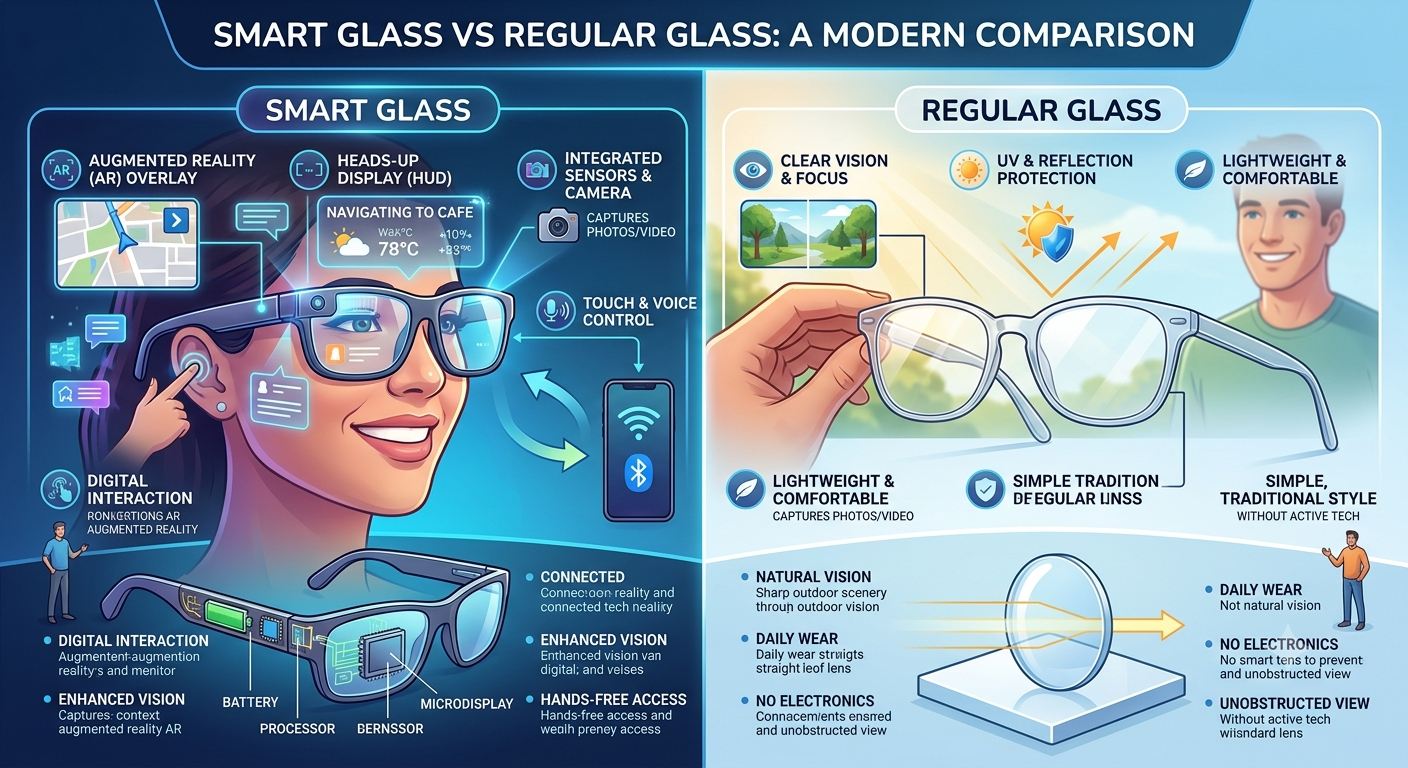
Between you and me, the gap between traditional eyewear and smart frames has completely closed in 2026. You no longer have to look like a cyborg to get built-in AI, directional audio, and prescription lenses all in one sleek package. Let’s break down exactly what you get with smart glasses, what you lose, and if making the switch is actually worth your hard-earned cash.
Why We Are Having This Smart Glasses vs Regular Glasses Comparison?
Look, regular glasses do one thing: they fix your vision. You pay $200 for a nice piece of acetate, slap some prescription lenses in them, and call it a day. But in 2026, dropping that kind of money on “dumb” plastic feels like buying a flip phone.
I made the switch because I was tired of carrying three different things in my bag. I had my reading glasses, my bulky noise-canceling headphones, and my phone constantly in my hand. Moving to smart glasses meant I could listen to Spotify, ask an AI assistant to translate a menu, and protect my eyes from UV rays and do a lot of things using smart glasses—all while keeping my hands totally free.
The technology has gotten so small and so clean that nobody even knows you are wearing tech. But there are very real trade-offs when it comes to battery anxiety, weight, and privacy that you need to know about before you swipe your card.
The Ultimate Breakdown: Smart Glasses vs Regular Glasses
Let’s put these two daily drivers head-to-head. I am breaking this down by the exact features you actually care about, skipping the boring tech jargon.
Vision, Prescription & UV Protection
Regular glasses give you a static lens, whether you need reading support, computer blue-light blocking, or standard distance correction. Smart glasses offer all of this, but brands now partner directly with major lens makers like Essilor to give you high-end prescription options right out of the box.
You can get smart frames as tinted sunglasses, clear screen protectors, or transition lenses that adapt to UV light outside. The vision quality is exactly the same across both, but smart glasses often feature thicker arms to hide the tech, which slightly reduces your extreme peripheral vision.
Audio, Bluetooth & Noise Control
This is where smart glasses totally wipe the floor with regular frames. Built-in Bluetooth 5.3 connects instantly to your phone, while tiny directional speakers in the arms pump audio directly into your ears.
You get rich sound without blocking the world around you, which is wildly safer for walking in the city than wearing earbuds. While they do not offer active noise cancellation like heavy headphones, the audio bleed is basically zero, meaning the person next to you on the train cannot hear your true crime podcast.
Cameras, AI & Augmented Reality
Regular frames look at the world; smart frames actively analyze it. Modern smart glasses pack 12MP ultra-wide cameras right into the bridge, letting you snap hands-free photos or livestream directly to your social feeds.
The built-in AI is the real star here. You can look at a landmark, tap your frames, and hear an instant history lesson, or look at a Spanish menu and hear the English translation. Augmented reality (AR) models even project a massive virtual screen in front of your eyes, though these tend to be slightly bulkier than audio-only models.
Displays, Battery Life & Charging
Standard glasses live on your face until you take them off. Smart glasses live on a battery timer, usually giving you 4 to 6 hours of continuous audio or active display time before they die.
When they do die, they just become regular glasses, which is a nice safety net. Charging is super easy now—most come with a sleek leather charging case that holds an extra 30 hours of juice, snapping magnetically to the frames just like wireless earbuds.
Weight, Fashion & Cost
Your standard acetate frames weigh about 15 to 20 grams, making them feel like nothing. Smart glasses pack batteries, speakers, and cameras into a 45 to 50-gram package, which you will definitely feel on the bridge of your nose after eight hours.
Fashion-wise, you are no longer limited to ugly, chunky plastic. You can buy smart frames in classic men’s and women’s styles, including round, wayfarer, and rectangle shapes that look identical to designer brands. Cost is the final hurdle: regular glasses average $150, while smart frames start at $300 and easily hit $500 with a custom prescription.
The Head-to-Head Spec Table between Regular Glasses & Smart Glasses
| Feature | Regular Glasses | Smart Glasses (2026 Average) |
|---|---|---|
| Vision/Prescription | Yes, full custom | Yes, full custom |
| Camera/Video | None | 12MP Ultra-wide, 1080p Video |
| Speakers/Audio | None | Open-ear directional, Bluetooth 5.3 |
| AI Integration | None | Voice-activated multimodal AI |
| Display/AR | None | Optional virtual screen projection |
| Battery/Charging | Infinite (No battery) | 4-6 hours active, 36h via case |
| Weight | 15g – 25g | 40g – 55g |
| Privacy Indicator | N/A | Bright front-facing LED when recording |
| Average Cost | $100 – $250 | $300 – $550 |
My Top Smart Glasses Picks for 2026
If you are ready to upgrade based on how do smart glasses look like on you, do not buy random junk. Stick to these three proven systems that actually deliver on their promises. Ray-Ban Meta Smart Glasses. These are the undisputed kings of everyday wear. You get a 12MP camera, incredible built-in Meta AI, and rich directional audio hidden inside the classic Wayfarer design. They weigh just 48 grams, come with a 36-hour charging case, and nobody will ever know you are wearing smart glasses.
Maintenance & Pro-Tips for Smart Frames
Taking care of smart glasses is a totally different ballgame than regular frames. You cannot just run these under the sink with dish soap when they get dirty.
- Clean Dry, Not Wet: Use a high-quality microfiber cloth and a tiny spray of lens cleaner directly on the cloth, never on the frames. Water will easily fry the microphone ports and speaker grilles hidden in the arms.
- Manage Your Battery: Treat your smart glasses like your phone. Turn off the “Hey Meta” or constant AI listening features if you are just sitting at your desk; it easily doubles your daily battery life.
- Respect Privacy Etiquette: The bright LED light turns on when you record, but people still get weirded out by cameras on faces. A quick “hey, taking a quick video of this view” goes a long way in keeping your friends comfortable.
Are you making the jump to smart glasses this year, or are you holding onto your classic wire frames until the tech gets even smaller? Drop a comment below and tell me what feature would actually make you switch. If you already own a pair, let the community know how the battery life is holding up for you!
Frequently Asked Questions
Can I get my exact prescription in smart glasses?
Yes. Major brands like Ray-Ban and XREAL allow you to order frames with custom prescription lenses directly, including reading, distance, and astigmatism corrections. You can also take most smart frames to your local eye doctor to have custom lenses cut and installed.
Are smart glasses heavy to wear all day?
They are noticeably heavier than regular glasses, usually weighing around 45 to 50 grams compared to a standard 20-gram frame. Most users adapt within a week, but you might feel slight pressure on the bridge of your nose during your first few days of all-day wear.
Can other people hear my music on smart glasses?
No, modern smart glasses use highly directional open-ear speakers that funnel sound directly into your ear canal. Unless you have the volume at 100% in a dead-silent room, the person sitting right next to you will not hear your music or phone calls.
Do smart glasses protect against UV rays and blue light?
Yes, you can customize the lenses just like regular glasses. You can order them as polarized sunglasses with 100% UV protection, clear lenses with blue-light computer filtering, or transition lenses that automatically darken when you step outside.
